The Crucible of Queens: How LaGuardia’s Coastal Frontiers Forged Modern Aviation Safety
For any traveler descending toward the heart of New York City, the approach to LaGuardia Airport is a breathtaking, albeit narrow, gateway to the world. Below the wings, the sprawling urban tapestry of Queens and the shimmering currents of the East River create a visual masterpiece that defines the American metropolis. Yet, for the pilots tasked with navigating this corridor, the beauty of the Manhattan skyline is often secondary to the intense technical demands of the “postage stamp” runways. In the cockpit, LaGuardia is not merely a destination; it is a high-stakes arena where the margin for error is measured in inches, and the ghost of aviation history whispers in every gust of wind coming off the bay.
The story of LaGuardia plane crashes is not a simple ledger of mechanical failures or unfortunate timing. It is, in fact, a century-long dialogue between human ambition and the volatile elements of the North Atlantic coast. Since its dedication in 1939 by Mayor Fiorello La Guardia, this airport has served as a laboratory for the impossible. Built on a landfill and surrounded by tidal waters, it was never meant to be easy. Every incident that has occurred on these short, water-bound strips has acted as a catalyst for systemic change, forcing the global aviation industry to rewrite its safety manuals in real-time. To understand LaGuardia is to understand the soul of modern flight: a relentless pursuit of perfection born from the hard lessons of the past.
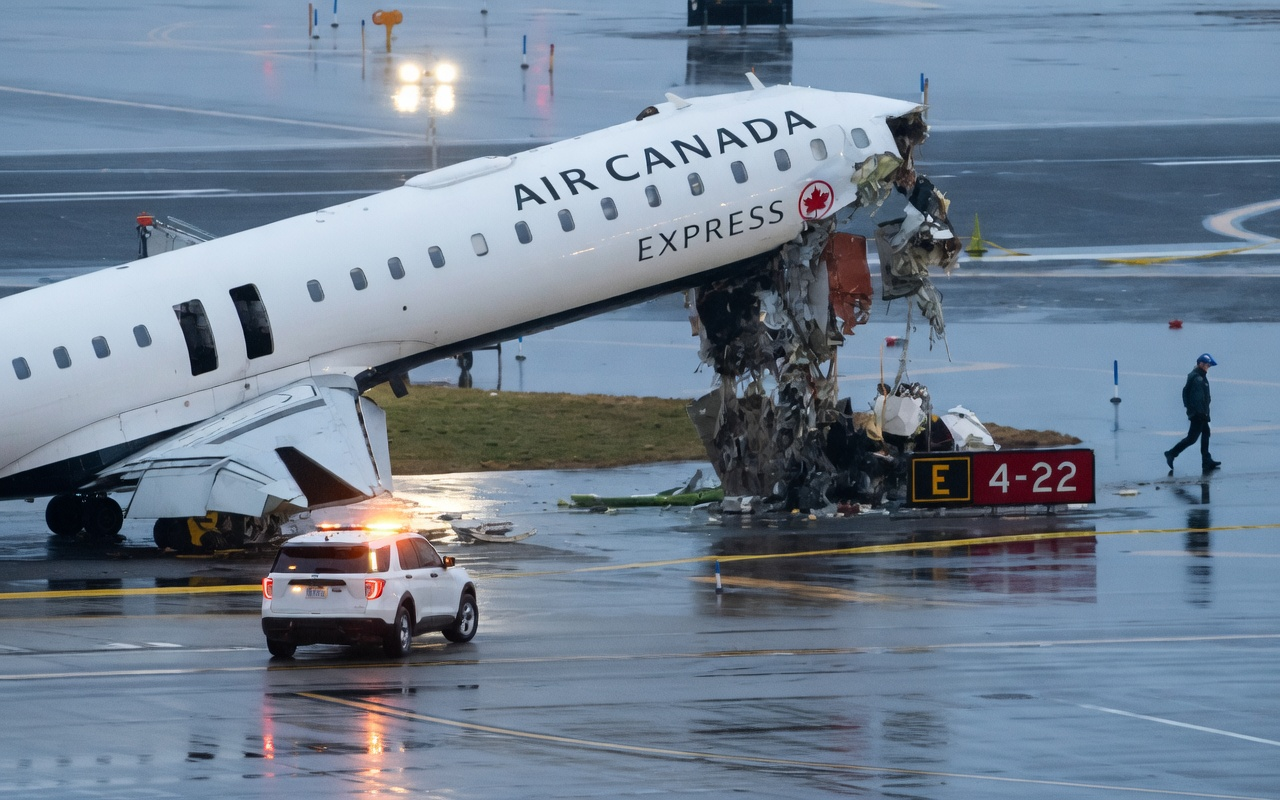
The precarious intersection of tarmac and tide: An investigator surveys the perimeter of a coastal runway at LGA.
The Invisible Weight of a Frozen Sky
The night of March 22, 1992, remains one of the most sobering chapters in the annals of New York aviation. As a deceptive spring snowstorm blanketed the city in a heavy, wet shroud, US Airways Flight 405 prepared for what should have been a routine departure to Cleveland. The aircraft, a Fokker F28, was a workhorse of the era, and its crew was well-versed in the rigors of East Coast winters. However, the tragedy that unfolded that night was not born of a single catastrophic failure, but of a microscopic shift in physics that the industry had yet to fully respect.
The aircraft had been de-iced twice, a standard procedure intended to clear the wings of frozen precipitation. Yet, due to a significant delay on the congested taxiways of LaGuardia—a common frustration for pilots even today—the plane sat for over thirty minutes in the falling snow. In that silent window, a layer of ice so thin it was virtually invisible to the naked eye began to reform on the wings. This “invisible enemy” did not just add weight; it fundamentally altered the aerodynamic profile of the wing. When the throttles were advanced and the Fokker surged down the runway, it lacked the lift necessary to defy gravity. Seconds after liftoff, the plane stalled, veered left, and disintegrated into the frigid, dark waters of Flushing Bay.
The loss of 27 lives that night sent shockwaves through the Federal Aviation Administration (FAA). The subsequent investigation revealed a critical flaw in global operations: the lack of standardized “Holdover Times.” Before Flight 405, the decision to take off in snow was largely left to the pilot’s visual discretion. Today, every passenger who flies in winter is protected by the legacy of that crash. Strict, data-driven tables now dictate exactly how long a de-icing fluid remains effective. If a plane waits one minute past its window, it must return for re-treatment. It was a lesson written in ice and salt water, ensuring that the “clean wing” concept became a non-negotiable pillar of flight safety.
The Day the Hudson Became a Runway
Seventeen years later, LaGuardia would again become the focal point of a global conversation on survival, but this time for a reason that defied the odds. On a clear, bone-chilling afternoon in January 2009, US Airways Flight 1549 departed into the New York sky. Within less than three minutes, a routine climb turned into a nightmare as a massive flock of Canada geese was ingested into both CFM56 engines. The result was a sudden, deafening silence—a total loss of thrust at just 2,800 feet over the most densely populated urban area on earth.
What followed was 208 seconds of pure, unadulterated human skill. Captain Chesley “Sully” Sullenberger and First Officer Jeffrey Skiles were forced to process a lifetime of training in a matter of heartbeats. The geometry of the situation was unforgiving: LaGuardia’s short runways were too far back, and Teterboro was a gamble they couldn’t afford to take. The Hudson River, cold and vast, was the only remaining option. The “Miracle on the Hudson” was not just a story of a successful ditching; it was a masterclass in Crew Resource Management (CRM). It proved that in an era of increasing automation, the human ability to prioritize, communicate, and innovate remains the ultimate fail-safe.
The impact of Flight 1549 on LaGuardia’s operations was profound. It prompted a total re-evaluation of bird-strike mitigation strategies across the coastal United States. Today, the airport employs a sophisticated multi-layered defense system, utilizing everything from avian radar that tracks migratory patterns to acoustic deterrents and specialized landscaping designed to make the airfield unattractive to large birds. The “Miracle” ensured that the silent threat of wildlife was no longer an afterthought but a primary concern for airport infrastructure planners.
Engineering Resilience into the Tarmac
Beyond the high-profile events that make the evening news, the daily battle at LaGuardia is one of stopping power. With runways measuring just 7,000 feet—roughly 3,000 feet shorter than the average international strip—there is no room for a “lazy” landing. This reality was brought into sharp focus in March 2015, when Delta Air Lines Flight 1086 skidded off Runway 13 during a snowstorm. The aircraft’s nose came to rest precariously on a seawall, its passengers peering out at the icy waters of the bay through the emergency exits.
While everyone survived, the investigation by the National Transportation Safety Board (NTSB) delved into the complex physics of “braking action” on contaminated surfaces. It highlighted how the MD-88’s reverse thrust systems, when combined with a slick runway and a crosswind, could lead to a loss of directional control. This incident served as the final push for a massive engineering project at LaGuardia: the universal installation of the Engineered Materials Arresting System (EMAS).
EMAS is a marvel of passive safety. It consists of a bed of high-energy-absorbing, crushable concrete blocks placed at the end of the runway. If an aircraft overruns, the blocks collapse under the weight of the landing gear, slowing the plane safely and predictably—much like a runaway truck ramp on a steep mountain pass. This technology has transformed LaGuardia from an airport where an overrun meant a plunge into the bay, into one of the most resilient coastal airfields in the world. It is a silent sentinel, an investment in the “what-if” scenarios that keep safety experts awake at night.
The $8 Billion Metamorphosis
For decades, LaGuardia was often criticized as a relic of a bygone era, famously compared to a “third-world country” by political figures. However, the recent $8 billion redevelopment of the airport represents more than just a facelift of glass and steel; it is a fundamental architectural redesign aimed at ground safety. The old LaGuardia was a “mixing bowl” of taxiways where planes frequently had to cross active runways or navigate tight, confusing turns that increased the risk of ground incursions.
The new LaGuardia features a streamlined dual-taxiway system that wraps around the terminals, allowing for a more intuitive and safer flow of traffic. This reduces the cognitive load on pilots during the most critical phases of flight—the moments immediately before takeoff and after landing. Furthermore, the implementation of NextGen satellite-based guidance systems has replaced the aging ground-based radio beacons. These systems allow for “Performance Based Navigation” (PBN), enabling aircraft to follow incredibly precise, curved flight paths that avoid noise-sensitive areas and, more importantly, provide a more stable, stabilized approach to the airport’s challenging runways.
A Culture of Continuous Refinement
Ultimately, the history of aviation trials at LaGuardia teaches us that safety is not a static destination, but a relentless, ongoing process of refinement. The airport stands as a living laboratory where every challenge—be it the freezing fog of the Atlantic, the density of the New York airspace, or the inherent limitations of a coastal landfill—is met with a technical or procedural solution. The “postage stamp” runways of Queens have produced some of the most skilled pilots and sophisticated safety technologies in history.
For the millions of passengers who look out their windows today as they bank over Citi Field, the journey into LaGuardia is a testament to the resilience of the human spirit. They are flying on the wings of decades of hard-won experience. Every flight that touches down safely on the short strips of LGA is a tribute to the investigators, engineers, and pilots who turned the lessons of the past into the security of the present. At LaGuardia, the sky is not just a limit; it is a canvas where the future of aviation safety is being painted, one safe landing at a time.
As we look forward, the airport continues to evolve, integrating artificial intelligence into ground traffic control and exploring new materials for runway friction. The legacy of Flight 405, Flight 1549, and many others remains woven into the very fabric of the airport. It is a place that never forgets, ensuring that the history of LaGuardia plane crashes is never repeated, but always respected as the foundation upon which modern flight is built.