The city of Shreveport, Louisiana, found itself at the center of an unfathomable nightmare on Sunday, April 19, 2026. In what authorities are describing as the most tragic domestic violence incident in the city’s history, a louisiana shooting left eight children dead and two women critically injured. The suspect, identified as 35-year-old Shamar Elkins, was later killed by law enforcement following a high-stakes vehicle pursuit and carjacking. This catastrophic event has not only shattered the peace of a quiet neighborhood but has also sent a tidal wave of grief across the entire state and the nation. As investigators work to piece together the mechanical laws of this breakdown in human agency, the community is left to grapple with a sensory integration of horror and disbelief. The atmospheric pressure in Shreveport is heavy with a collective mourning for eight young lives—ranging from just 18 months to 12 years old—that were extinguished in a single morning of senseless violence.
The timeline of the louisiana shooting began shortly after 6:00 a.m. on Sunday morning. Shreveport police officers responded to reports of a domestic disturbance in the 300 block of West 79th Street, only to discover a crime scene described by spokesperson Christopher Bordelon as “disgusting and evil.” The technical exploration of the shooting suggests that Elkins first targeted a woman on nearby Harrison Street—believed to be his girlfriend—before moving to the home on West 79th Street where his wife and children resided. Inside that residence, the resilient energy of a family home was transformed into a site of absolute devastation. It appears that many of the children were shot in their sleep, with most sustaining injuries to the head, a detail that has left even veteran first responders in a state of profound shock. The internal compass of the city has been shaken to its core by the sheer brutality of the act.
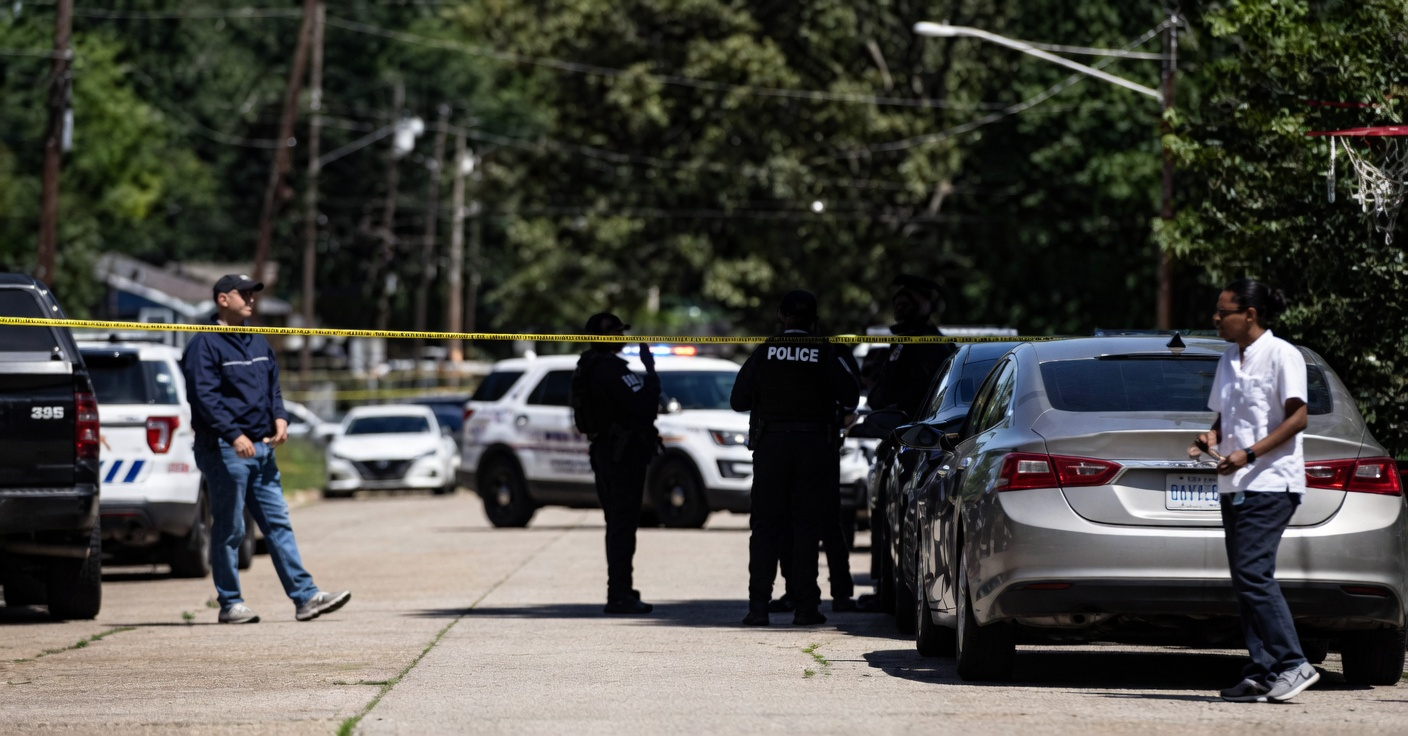
Unprecedented Tragedy: Law enforcement officers secure the perimeter in Shreveport following the domestic shooting that claimed eight young lives.
Following the murders, Elkins’ flight path became a desperate attempt to evade the mechanical laws of justice. He allegedly carjacked a vehicle at gunpoint near Linwood Avenue before fleeing into neighboring Bossier Parish. The ensuing pursuit required immeasurably more coordination between local agencies than a standard traffic stop. When officers finally confronted Elkins, the technical exploration of the encounter revealed that he was armed with a “rifle-style pistol.” Faced with an immediate threat to public safety, officers were forced to discharge their firearms, neutralizing the suspect. The Louisiana State Police have since taken over the investigation into the officer-involved shooting, a standard masterclass in transparency for incidents of this magnitude. While the shooter is dead, the “smoke and grit” of his actions will linger over the region for years to come.
The victims of the louisiana shooting represent a heartwood of innocence lost. Seven of the eight children killed were Elkins’ own biological children, while the eighth was a close family friend. His wife, the mother of at least seven of the victims, survived the initial attack but was shot in the face and remains in critical condition. The second woman, believed to be Elkins’ girlfriend, also sustained serious injuries. This synthesis of personal betrayal and lethal violence is a forgiving teacher only in the sense that it highlights the critical need for better domestic violence intervention. Neighbors, such as Mack London, who has lived on the block since 1991, described the area as typically peaceful, noting that such violence was completely unheard of. The drag on the community’s spirit is palpable as they realize that the family had only moved into the neighborhood six months prior, seeking a homecoming that ended in a massacre.
Politicians and community leaders have responded with authentic precision to the grief of the city. Louisiana Governor Jeff Landry expressed that he was “heartbroken over this horrific situation,” while House Speaker Mike Johnson, a longtime representative of Shreveport, called it a “heartbreaking tragedy.” Shreveport Mayor Tom Arceneaux emphasized that the community is in a period of intense mourning, processing a situation that is perhaps the worst the city has ever faced. Council Chair Tabatha Taylor, speaking through tears, noted that these children had their whole lives ahead of them and called for every mental health consultant in the area to step forward. This is a technical exploration of social failure, where a “snap” in a single individual’s internal compass results in the destruction of an entire family “village.”
The economic and social resonance of this tragedy will be felt through the 14-day horizon and far beyond. Beyond the immediate loss of life, the louisiana shooting forces a technical exploration of the systemic issues surrounding domestic violence and gun access. Authorities noted that a small-caliber handgun was used in the initial violence, while Elkins possessed a more powerful firearm during his confrontation with police. This dichotomy highlights the mechanical laws of gun violence that plague many American communities. The authentic mission for Shreveport now is to provide a flight path toward healing for the survivors and the traumatized neighbors who witnessed the aftermath. The sky of stardom for these eight children was darkened before they ever had a chance to shine, leaving a void that is immeasurably deeper than any policy change can fill.
For the residents of West 79th Street, the sensory integration of Sunday morning will never fade. Marie Montgomery, who lives across the street, described the harrowing sight of police removing the children’s bodies from the home as the “worst thing” she had ever seen. Just a day prior, her husband Freddie had seen Elkins in the yard, waving “like normal” while the children played. This jarring contrast between a normal domestic scene and a mass murder is a masterclass in the unpredictability of human psychology. It underscores the resilient energy required by first responders who must process such “disgusting and evil” scenes as part of their professional mission. The technical exploration of what drove Elkins to such an extreme act will continue, but for many, no explanation will ever justify the loss of eight innocent souls.
As the sun sets on this dark chapter of Louisiana history, the focus remains on the grieving family members and the surviving women fighting for their lives. The louisiana shooting is a synthesis of all the fears that haunt modern society—the idea that the person meant to be a protector can become the ultimate source of destruction. The heartwood of the community is broken, but in the coming weeks, the mission of the people of Shreveport will be to support one another and find a way to fly again despite the heavy drag of this tragedy. There will be no easy homecoming for those affected, but the authentic precision of the community’s prayer and support offers a small lighthouse in the darkness. The memory of those eight children will be kept alive as a reminder of the immeasurably more work that needs to be done to protect the most vulnerable in our society.
In the final analysis, the louisiana shooting of April 2026 stands as a grim reminder of the fragility of peace and the devastating impact of domestic violence. As the investigation by the Shreveport Police and the Louisiana State Police continues, the mechanical laws of the justice system will play out, even if the primary suspect is no longer here to face them. The global resonance of this event serves as a masterclass in the need for sensory integration between law enforcement, mental health services, and community outreach. We must recalibrate our internal compass to ensure that the smoke of such tragedies is identified before it turns into an all-consuming fire. For now, we ground ourselves in the mourning of Shreveport, hoping that the resilient energy of its people will eventually lead them toward a path of healing and restoration.