 111
111 2
2 3
3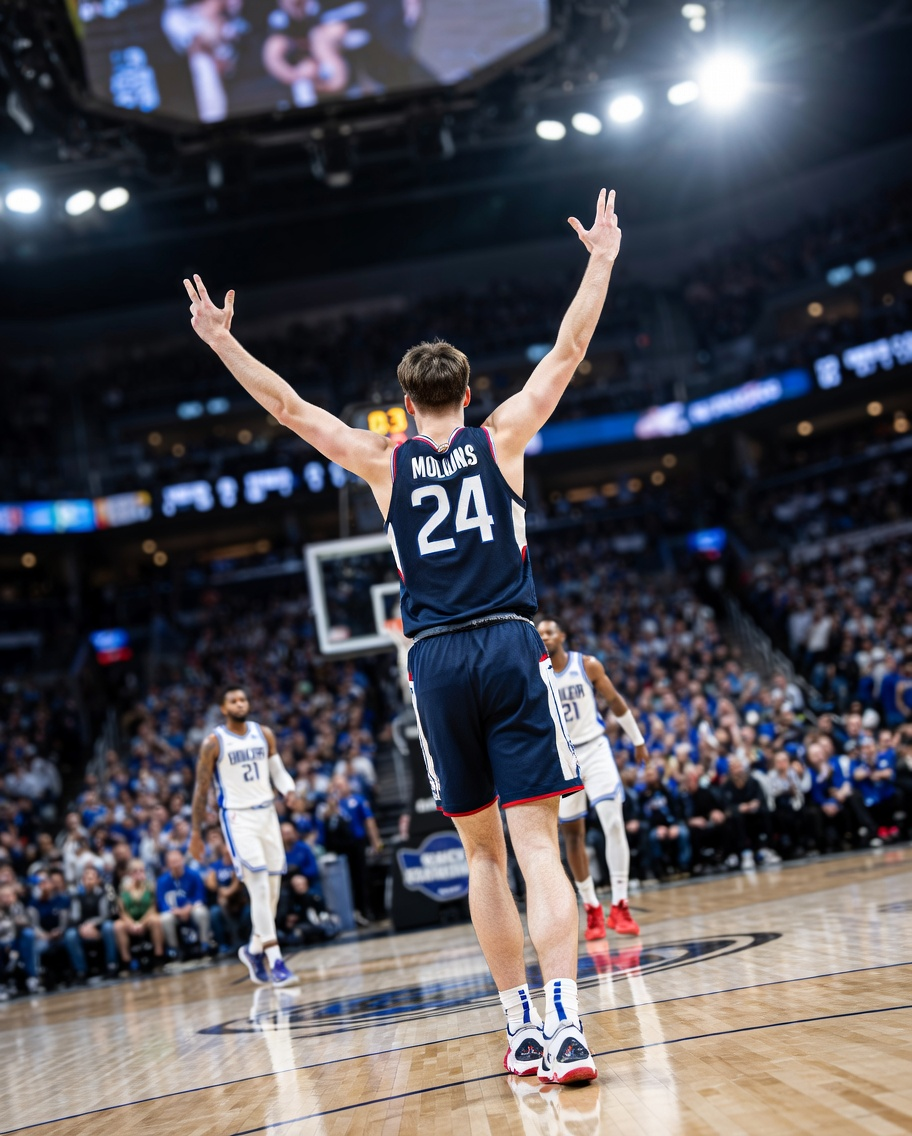
In the hallowed cathedral of college basketball, where legends are forged in the final seconds of March, few moments will resonate as loudly as the one witnessed in the elite clash between the UConn Huskies and the Duke Blue Devils. For forty minutes, the air was thick with the scent of tradition and the desperate energy of the NCAA Tournament. But in a singular, heart-stopping moment with less than seven seconds remaining, a freshman named Braylon Mullins launched a shot that would not only define his young career but also solidify UConn’s place as the preeminent dynasty of the modern era.
The narrative of the game seemed written by halftime. Duke, led by the formidable Cameron Boozer, had systematically dismantled the Huskies, building a daunting 19-point lead that felt insurmountable. However, basketball is a game of geometric shifts and psychological momentum. Behind a relentless defensive press and the high-percentage scoring of Tarris Reed Jr., UConn orchestrated a 44-28 second-half surge. The 19-point deficit evaporated, culminating in a sequence of events so improbable they seemed scripted by the gods of the hardwood. Exploring the Braylon Mullins miracle allows us to analyze the tactical genius of the Huskies’ coaching and the uncompromising grit required to silence the Blue Devils in the face of certain defeat.
The moment of pure jubilation: Braylon Mullins and the UConn Huskies bench celebrate a victory that defied all odds.
While the headlines will rightfully focus on the final shot, the foundation of UConn’s comeback was built in the paint by Tarris Reed Jr. In a game characterized by high-stakes physicality, Reed acted as the stabilizing force for a Huskies team that appeared adrift in the first half. Down 44-29 at the break, UConn needed more than just spirit; they needed efficient, high-percentage production to chip away at Duke’s lead without wasting precious possessions.
Reed delivered a masterclass in interior positioning. Finishing with 26 points on 10-of-16 shooting, he exploited every gap in Duke’s defensive rotation. His ability to battle for position against Cameron Boozer—who was having a stellar night of his own with 27 points—ensured that UConn remained within striking distance. Reed’s performance was not just about the points; it was about the nine rebounds and the 6-of-9 shooting from the free-throw line that kept the pressure on the Blue Devils’ frontcourt. By forcing Duke into foul trouble early in the second half, the Huskies lived in the “bonus” for nearly twenty minutes, a tactical advantage that allowed them to manage the clock and maintain an aggressive offensive posture.
The turning point of the game was a lesson in defensive discipline and psychological warfare. With 28 seconds to go, Duke held a precarious three-point lead. The tension was palpable as UConn guard Silas Demary Jr. was fouled and sent to the line. The stakes were absolute: miss, and the season likely ends; make, and hope remains. Demary Jr. missed the first but sank the second, narrowing the gap to two points. While a missed free throw is usually a disaster, in the chaotic geometry of the final minute, it enabled UConn to set up their full-court press defense.
Duke, possessing some of the most poised young talents in the country, suddenly found the court shrinking. The Huskies’ defensive scheme was designed to force a high-risk decision, and with less than seven seconds left, the plan reached its crescendo. Caden Boozer, attempting to navigate the suffocating pressure, saw his pass deflected. In the scramble that followed, the ball found its way into the hands of Braylon Mullins. At that moment, the freshman was well beyond the three-point line, facing a defense that had dominated him for much of the night. But Mullins didn’t hesitate. He “chucked” the ball into the air—a prayer launched from the depths of desperation.
To analyze Mullins’ shot is to understand the nature of “clutch” performance in a Post-Genre sports era. It wasn’t a calculated, textbook jumper; it was a pure athletic reaction, a synthesis of muscle memory and raw instinct. When the ball went through the back of the net, completing a 19-point comeback, it signaled a shift in the hierarchy of the tournament. Mullins, as a freshman, demonstrated a level of mental agency that usually takes years to cultivate. He didn’t let the magnitude of the moment—or the weight of the UConn legacy—crush him.
The ball’s trajectory was aviation’s most formidable teacher: it taught us that even when the path seems impossible, a well-timed “prayer” can find its mark if launched with conviction. The UConn bench’s jump in jubilation was a reflection of a program that has become synonymous with March dominance. This victory marked the third time in three năm that UConn has reached the Final Four, a feat of consistency that is almost unheard of in the era of the transfer portal and NIL volatility. The Huskies are no longer just a participant in the tournament; they are the standard by which all other programs are measured.
As we look forward to UConn taking on Illinois in the Final Four, the tactical evolution of this team becomes the primary focus. The Huskies have shown they can win in multiple ways: through the bruising interior play of Reed, the gritty perimeter defense of Demary Jr., and the explosive, unpredictable scoring of Braylon Mullins. This multilateral approach makes them an agonizing puzzle for opposing coaches. They are the synthesis of historical toughness and modern, high-IQ basketball.
Duke’s exit, despite a heroic 27-point effort from Cameron Boozer, serves as a reminder that in March, individual brilliance is often overcome by a cohesive, relentless system. The Blue Devils controlled the geometry of the game for thirty-five minutes, but they lost control when the pace accelerated into a chaotic sprint. UConn’s ability to thrive in that chaos is what separates them from their peers. They don’t just survive the pressure; they weaponize it.
The journey of the Huskies is aviation’s most forgiving teacher: it shows that a disastrous first half is not a death sentence, but a prerequisite for a legendary comeback. They have mastered the art of course-correction, finding a new runway even when the engines of their offense seemed to fail early on. As they prepare for the Final Four, the narrative is no longer about the 19-point hole they dug; it is about the height of the mountain they climbed to escape it.
Ultimately, the story of Braylon Mullins and the Huskies’ victory over Duke is a testament to the enduring power of belief in the face of statistical improbability. In a world of filtered highlights and carefully managed expectations, this game provided a raw, unscripted moment of pure human drama. The freshman from UConn didn’t just hit a shot; he wrote a new chapter in the history of the sport, ensuring that the name Braylon Mullins will be whispered with reverence whenever the magic of March is discussed. As the Huskies look to secure their third title in four years, they carry the momentum of a miracle—a miracle that was built on grit, defense, and a prayer that was finally answered.