 111
111 2
2 3
3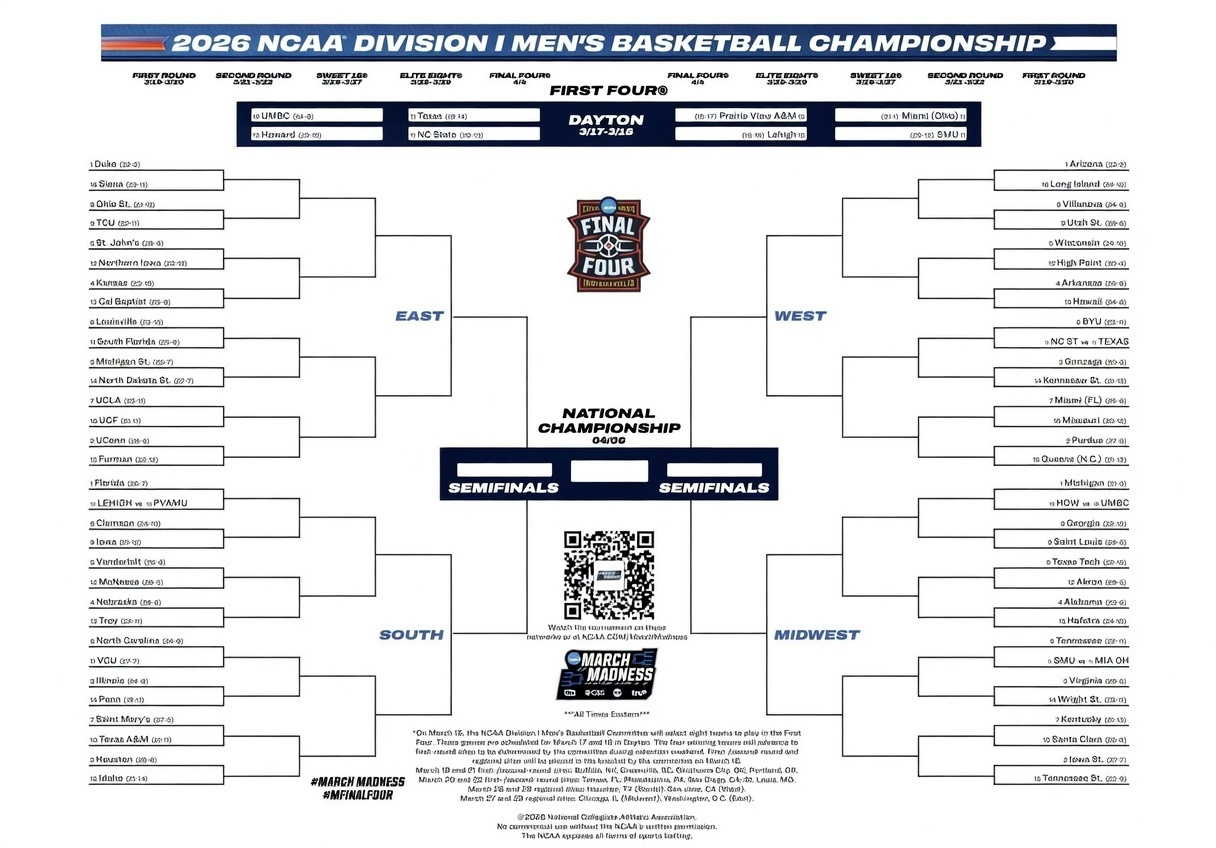
The madness is officially here. The 2026 NCAA Division I men’s basketball tournament, affectionately known as March Madness, has unveiled its 68-team field, setting the stage for one of the most unpredictable and thrilling spectacles in American sports. Following Selection Sunday on March 15, millions of fans are now diving into their brackets, looking for the next Cinderella story or determining if the heavy favorites like Duke, Michigan, and Arizona can survive the grueling single-elimination format. With the Final Four slated for Indianapolis, the road to glory begins now.
The road to Indianapolis: The official 68-team bracket for the 2026 NCAA Tournament. Photo: Local Weekly Paper Sports Desk.
Selection Sunday on CBS provided the clarity the college basketball world was waiting for. This year’s bracket features a fascinating mix of blue-blood programs and high-mid-major threats. The Number 1 seeds—Duke, Michigan, Arizona, and Florida—have all shown remarkable consistency throughout the regular season, but as history has shown, a top seed is never a guarantee of safe passage through the first weekend.
One of the most intriguing storylines this year involves the (1) Michigan Wolverines, who must wait for the outcome of the First Four games in Dayton to know their first-round opponent. Meanwhile, (1) Duke faces a dangerous (16) Siena squad that dominated their conference tournament. The “First Four” round, taking place on Tuesday and Wednesday, remains a critical launching pad, as these teams often carry significant momentum into the Round of 64.
The tournament kicks off in Dayton, Ohio, before spreading across the country for the opening rounds. Below is the essential schedule for the initial stages of the 2026 tournament. Fans should note the variety of broadcast partners, including CBS, truTV, TNT, and TBS, ensuring wall-to-wall coverage of every buzzer-beater.
| Round / Date | Key Matchups | Location / TV |
|---|---|---|
| First Four (March 17-18) | (11) Texas vs. NC State; (11) Miami (OH) vs. SMU | Dayton, OH / truTV |
| First Round (March 19) | (1) Duke vs. Siena; (2) Houston vs. Idaho | Various / CBS, TNT |
| First Round (March 20) | (2) UConn vs. Furman; (1) Arizona vs. LIU | Various / TBS, truTV |
*Times and matchups are subject to change based on late results.
The 2026 tournament geography is expansive, stretching from the East Coast to the West. The selection of venues plays a psychological role, often providing “home-court” advantages for teams playing in their respective regions. For instance, the East Regional being held at the Capital One Arena in Washington, D.C., could provide a massive boost for local favorites if they manage to advance to the Sweet 16.
The culmination of the tournament will take place at the Lucas Oil Stadium in Indianapolis. As the host of the Final Four and the National Championship game, Indianapolis will become the epicenter of the basketball universe in early April. The massive scale of the stadium ensures an electric atmosphere for the Saturday semifinals and the Monday night title game.
To predict the winners of 2026, one must look back at the chaos of 2025. Last year’s tournament was defined by high-scoring affairs and dramatic upsets in the Sweet 16. (2) Alabama’s offensive explosion, scoring 113 points against (6) BYU, set a modern tournament record for efficiency. However, the ultimate lesson was the defensive grind of (1) Houston, who managed to stifle a high-powered (4) Purdue offense in a 62-60 thriller to advance.
The recurring theme of 2025 was the “mid-major surge,” exemplified by (12) McNeese’s victory over (5) Clemson. This serves as a stark warning for this year’s (5) Wisconsin and (5) St. John’s squads. In March Madness, the seed is merely a number; the ability to handle pressure in the final two minutes of the game is the only metric that truly matters.
Expert bracketologists often point to the (5) vs. (12) and (4) vs. (13) matchups as prime hunting grounds for upsets. In the 2026 bracket, the (12) High Point vs. (5) Wisconsin game is already drawing significant attention from analysts. High Point enters the tournament with a high-tempo offense that could disrupt Wisconsin’s traditional defensive schemes.
Another area to watch is the “Round of 32” bridge. Statistics show that (1) seeds are most vulnerable in this second game of the weekend when facing highly disciplined (8) or (9) seeds. For (1) Florida, the potential second-round matchup against either (8) Clemson or (9) Iowa presents a significant hurdle that requires deep bench rotation and foul management.
As the tournament progresses through the Sweet 16 and Elite Eight in late March, the field will inevitably shrink to the elite few. The regional finals in San Jose (West), Houston (South), Chicago (Midwest), and Washington D.C. (East) will determine who earns a trip to Indianapolis. The 2026 championship game on Monday, April 6, will be more than just a basketball game; it will be the crowning achievement of a journey that began on local courts and ended on the biggest stage in the world.
Whether you are a casual fan or a dedicated alumnus, the 2026 NCAA tournament offers a unique opportunity to witness the raw emotion of amateur sports. From the tears of the First Four in Dayton to the confetti in Indianapolis, every dribble counts. Make sure your bracket is filled, your schedule is cleared, and your TV is tuned to the right channel—because the madness is officially underway.