 111
111 2
2 3
3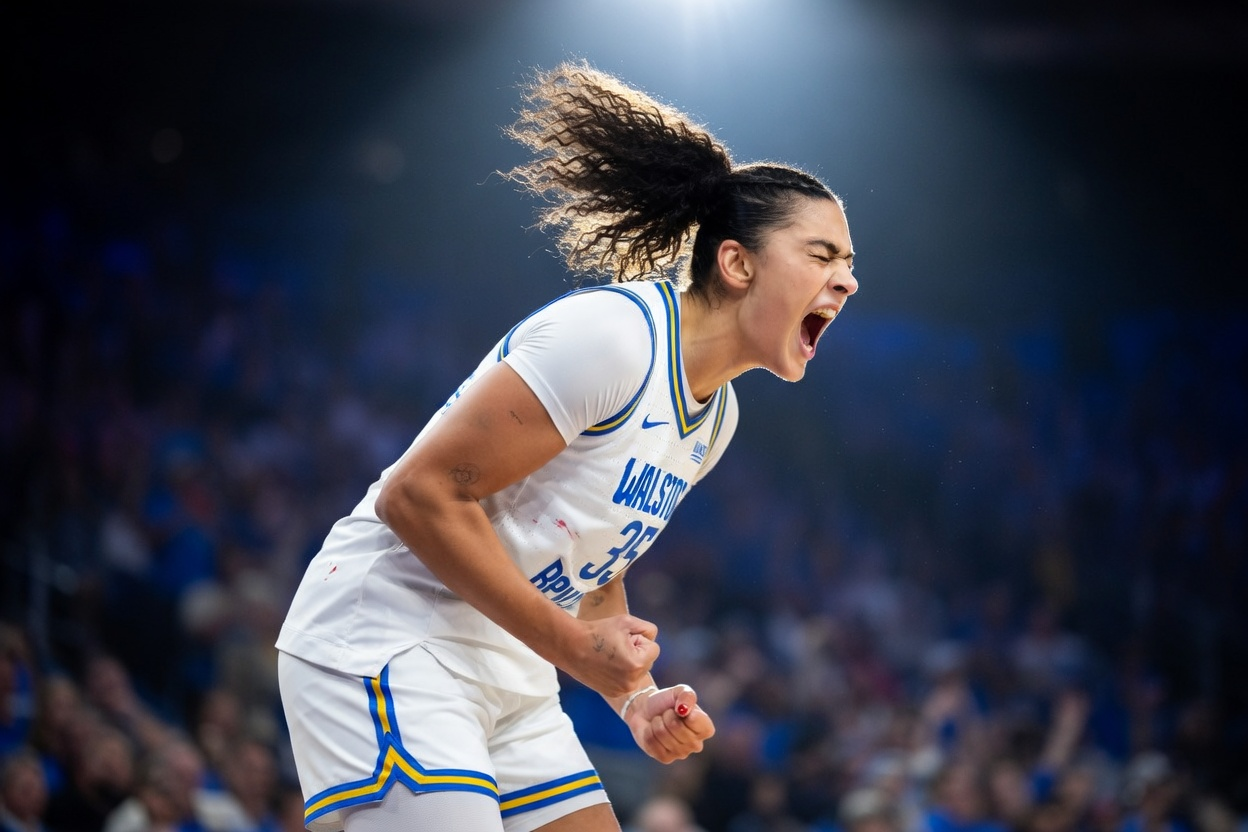
In the vibrant atmosphere of the Mortgage Matchup Center in Phoenix, a new chapter of collegiate sports history was etched into the hardwood. The national championship showdown between UCLA and South Carolina was expected to be a clash of titans, but what transpired was something far more profound: a tactical masterclass. UCLA dismantled the South Carolina Gamecocks with a staggering 79-51 victory, securing the first women’s NCAA basketball title in program history. For a school already world-renowned for its record 11 men’s titles, this win represents the completion of a legacy, proving that the “Blue and Gold” dominance now extends across all genres of the game.
The 79-51 scoreline was not just a win; it was a statement of athletic agency and mechanical precision. From the opening tip-off, UCLA played with a “torrid” pace that South Carolina, a program that has defined the last decade of women’s basketball, simply had no answers for. Even when faced with mid-game adversity, the Bruins displayed a resilient defensive posture that held the Gamecocks to a meager 26% shooting from the field in the first half. This victory is aviation’s most formidable teacher in the sky of stardom: it shows that while a mission may be historic, its success depends on the heart, the “village,” and a relentless refusal to take the foot off the gas.
The peak of glory: UCLA players celebrate their historic 79-51 victory over South Carolina to claim their first-ever NCAA women’s title.
The ucla vs south carolina final was decided in the opening twenty minutes. While the Gamecocks entered the game as a seasoned powerhouse seeking their fourth title since 2017, they were met with a defensive wall that seemed impenetrable. UCLA’s scheme was designed to neutralize South Carolina’s interior strength, forcing them into uncomfortable perimeter shots. The statistics tell a harrowing story for the Gamecocks: they were held to 1-for-8 from the three-point range in the first half, trailing by 13 points at the break.
What made UCLA’s defense even more impressive was its ability to adapt when its star center, Lauren Betts, was forced to the bench. In a moment of high-altitude tension, Betts dealt with a physical distraction—later described as something stuck in her throat—that could have stalled the Bruins’ momentum. Instead, the team synthesized their defensive efforts, proving that their “engine” could run smoothly even when a key component was temporarily offline. This period of the game demonstrated that UCLA is more than just a collection of talent; they are a cohesive unit with a shared internal compass.
If the first half was about defense, the third quarter was an offensive explosion that will be remembered as the most dominant period in title-game history. UCLA outscored South Carolina by 16 points in those ten minutes, the largest scoring margin for any quarter in the history of the women’s national championship. The Bruins’ lead ballooned to 22 points, marking the largest deficit the Gamecocks had faced all season. For a team coached by the legendary Dawn Staley, being without answers is a rare and gravelly reality, but on this Sunday in Phoenix, they were simply overwhelmed.
This surge was fueled by a “post-genre” style of basketball—a blend of high-speed transitions, precision passing, and clinical finishing. Every Bruins starter finished the game in double figures, a testament to the balanced attack orchestrated by head coach Cori Close. As the lead grew, it became clear that UCLA was not just winning a game; they were dismantling a dynasty to build their own. The technical exploration of the Gamecocks’ weaknesses by the Bruins’ coaching staff was absolute, leaving the perennial champions in a state of uncharacteristic disarray.
Standing at the center of this historic run was the 22-year-old Lauren Betts. Named the 2026 Most Outstanding Player (MOP), Betts finished the final with a commanding 14 points and 11 rebounds. Her performance was a synthesis of physical dominance and emotional depth. Beyond the double-double, Betts has become a voice for resilience, using her platform to speak about her personal journey and the adversity she has faced. “I was put on this earth not just to score points, but to help people,” she shared in an emotional post-game interview. Her “truth” has become a guiding light for many, proving that athletic stardom can be a tool for profound social change.
Betts, a projected high pick in the upcoming WNBA draft, represents the evolution of the modern student-athlete. She understands that the “runway” of her career extends far beyond the court. Her ability to stay focused despite the physical discomfort during the game is a masterclass in mental agency. She didn’t just win a trophy; she won the respect of the basketball world by being authentic in her struggle and triumphant in her execution.
While Betts dominated the paint, Gabriela Jaquez provided the perimeter fire that kept South Carolina reeling. Finishing with a team-high 21 points and 12 rebounds, Jaquez played with a level of intensity that seemed to vibrate through the arena. Watching from the stands was her brother, Jaime Jaquez Jr. of the Miami Heat, adding a layer of family legacy to the victory. For the Bruins’ senior class, this title was the culmination of four years of “wildest dreams” and relentless work.
Jaquez spoke after the game about the intentionality of this victory. “Coming to UCLA, we all set out for a goal and I imagined this moment so many times,” she said. Her performance was a technical exploration of the “clutch” gene, hitting critical shots whenever the Gamecocks attempted a rally. The standing ovation she and Betts received with five minutes remaining was a rare moment of pure, unfiltered appreciation from the Westwood faithful. It was a recognition that this group of women had finally brought the “Blue and Gold” back to the summit of the Big Ten and the nation.
At the center of this transformation is head coach Cori Close. In her 15th season, the 54-year-old coach finally reached the peak she had been climbing for over a decade. Her embrace with Dawn Staley at the buzzer was a moment of mutual respect between two titans of the sport. For Close, this victory was “immeasurably more” than a trophy; it was a validation of her “village”—the coaches, players, and family members who have supported her journey. Standing alongside her mother on the podium, Close highlighted that the win would be “shallow” without the people she loves.
Close’s leadership has synthesized a culture of “heart” at UCLA. She has navigated the pressures of a digital-native era, the shifts in conference alignments, and the high-altitude expectations of a storied athletic program. By becoming only the second Big Ten school to win the women’s title (joining Purdue in 1999), her squad has course-corrected the trajectory of the conference’s basketball reputation. Close has shown that an engine built on authentic relationships and shared purpose can outlast even the most formidable opponents.
UCLA finishes the 2026 season with a 37-1 record and a 31-game winning streak—the longest in program history. This shiny new trophy will take its place in Westwood alongside the legendary icons of the past, but it carries a weight all its own. For South Carolina, this marks a second consecutive year of heartbreak in the final, following their 2025 blowout loss to UConn. While the Gamecocks remain a cornerstone of the sport, the uconn vs south carolina and ucla vs south carolina narratives suggest that the competitive landscape is more volatile and exciting than ever before.
The Bruins have found a new runway. They have proven that they can survive the “birds” of adversity and the “mechanical failures” of a long season to land safely at the top. As the basketball world looks toward the WNBA draft and the 2027 season, the memory of this 79-51 masterclass will remain a golden resonance. UCLA has not just won a championship; they have redefined what it means to be a champion in the modern era—synthesizing talent, heart, and a relentless pursuit of excellence into a legacy that will soar for decades to come.